*(Commemorative ceremony to pay homage to Teacher Buraphachan Wai Kru for the year B.E.2566).
*Come with original temple box. Encased with waterproof transparent acrylic casing.
Phra Sivali is an arahant that the Lord Buddha regarded as an attagga in terms of great fortune. Beloved by all gods and humans.
In the ancient texts of the Burapha teachers of the Tai Yai people. There is a mention of how to create & conjure. Special training for Phra Sivali say so far. If a type of wood is carved. Then different rights are trusted to the fullest according to the textbook. If offering one food to you. His Highness miraculously turned his back. Khao Som Tor that was presented to him when donkeys and then brought to the birds to eat. Whichever direction the bird carries, we worshipers will have good fortune from that direction. The old man said like this….
Phra Sivali
At the time of the Buddha Gotama there reigned a righteous King and Queen named Koliya and Suppavasa. After some time Queen Suppavasa conceived a child. The unborn child brought great fortune to the kingdom. Not only did the queen receive many gifts from friends and relatives, the whole kingdom became prosperous. Crops grew in abundance and everyone was well-fed and healthy. The queen grew heavy with child but when the natural time for the birth arrived, she failed to deliver the baby. She grew uneasy as time passed by with still no signs of the birth, and asked the King to invite the Buddha and His retinue of monks for a meal. After the meal the Buddha blessed the queen by saying:
"May Suppavasa, daughter of the Koliya clan,
Be happy and healthy and give birth to a healthy son."
After the Buddha left, the queen gave birth to a beautiful, healthy son. As a mark of respect for the Buddha, who had eased the queen’s heavy burden with His blessings, invited the Buddha and his retinue to receive alms at the palace for seven days. They named the prince Sivali, as from the time of his conception; the people’s hardships were alleviated through an abundance of rich crops.
One day when Phra Sariputta was on his alms round he visited the prince and informed him of the suffering that he and his mother had undergone because of the delayed pregnancy. Phra Sariputta then went on to explain to the prince the unwholesome action that his mother and he had performed and the resulting effects of their actions.
In a previous birth Phra Sivali had been born as the King of Benares and had waged war on a neighboring kingdom. He had surrounded the kingdom and told the citizens to surrender or fight back. When they refused to surrender, in collaboration with his consort, his present mother, he had decided to surround the city and hold them hostage until they did so. The citizens, who did not want to fight back or live under the rule of such a king, had not surrendered. As a result, they had suffered greatly without food for a very long period. Many of the sick and the elderly had died but the arrogant king and his queen had not given in. Many months later the King had withdrawn his troops and released his hostages but he had paid dearly for the suffering he had caused. At death he was reborn in Avichi hell. The delayed pregnancy and the suffering he and his mother had undergone resulting from the delay were the residual effects of this action.
After illustrating the Noble Truth of suffering, Phra Sariputta asked the prince if he would like to join the Noble Order so that he could seek the path to end all suffering. The prince was overjoyed at this invitation and agreed to join the order with his mother’s permission.
The queen, who was a devoted follower of the Buddha, agreed. She escorted Prince Sivali in procession to the monastery to be ordained. On the day of ordination when they shave his hair, Phra Sariputta advised Phra Sivali to meditate on the impurities of the body. Phra Sivali, who was spiritually advanced resulting from previous wholesome actions, focused his mind as instructed. Before the completion of the shaving of his hair, Phra Sivali attained the supreme wisdom of Nibbána.
The monks soon noticed a strange phenomenon when they were with Phra Sivali as Phra Sivali always seemed to have an abundance of rich, fragrant food and the other requisites (robes, shelter and medicine). Monks who were with him also had the opportunity to share in the bounty. Wherever Phra Sivali went, people flocked around to prepare food for him. Donors offered Phra Sivali with all the requisites of a monk every time he went on his alms round.
Therefore, it was that wherever Phra Sivali travelled both people and devas supported him. He and his retinue of 500 monks were in an uninhabited forest for seven days, but they were not short of food. The Devas made sure that they fulfil all his requirements. Similarly, when Phra Sivali was travelling through the desert he was well provided with requisites. The Buddha, seeing that Phra Sivali was fulfilling a previous aspiration in His reign, declared that he was foremost among the monks in obtaining requisites. He also instructed monks who were travelling on long, tedious journeys through uninhabited terrain be accompanied by Phra Sivali, as with him by their side they would be ensured of the requisites. In fact, on one occasion when the Buddha and His retinue of 30,000 monks were travelling to visit Phra Khadhiravaniya Revata (Phra Sariputta’s younger brother) they had to cross an uninhabited forest. Phra Ánanda, fearing that they would not be able to obtain food in the jungle for such a large number of monks, questioned the Buddha about the logistics of the journey. The Buddha assured Phra Ánanda that they had nothing to worry about as Phra Sivali was with them. With Phra Sivali present, there would be no shortage of food because even the Devas reveled in taking care of his requirements.
In general, only the doer reaps the effects of one’s wholesome and unwholesome intentional actions. However, there are instances, as with Phra Sivali, that others too benefit from unusually strong actions of another. This overflow of the results of the effect of a persons strong kamma on others is known as nissandha pala (overflowing results of kamma). While vipaka pala, results of kamma are reaped only by the doer nissandha pala are experienced by others who happen to be with you. Nissandha pala could be both wholesome and unwholesome in accordance with the deed performed. For instance, Phra Sariputta did not obtain alms in one instance resulting from the nissandha pala of Losaka’s strong unwholesome deeds.
To seek the cause of this strange phenomenon we need to go back many aeons to the time of the Buddha Padumuttara. Phra Sivali, who had been born as a poor man, had the opportunity to see the Buddha Padumuttara confer on another monk the honor of being foremost among monks who obtain the requisites. Fascinated by the way, everyone desired to provide alms and robes to this monk; Phra Sivali had decided that he too would like to hold a similar position in a future birth. He had then performed many acts of generosity to the Buddha Padumuttara and His retinue and made an aspiration.
The Buddha Padumuttara, foreseeing that Phra Sivali’s aspiration would be fulfilled had prophesied that at the time of the Gotama Buddha he would be foremost among the monks who obtained requisites. From this point onwards, Phra Sivali had started in earnest to work toward his aspiration. At death, he was reborn in a heavenly realm where he enjoyed many years of heavenly bliss.
Phra Sivali is worshiped by Thai people as the greatest fortune-fetching monk. Phra Sivali was an important disciple of Lord Buddha. He was praised by the Lord as the most miraculous monk for fortune. Some say that Thai Bhikkhu’s pay reverence to Phra Sivali Thera that brought prosperity to Thailand, a Theravada Buddhist country. Phra Sivali thera was also known as the deity who brought in good luck and wealth in abundance.
Phra Sivali that made by Kruba Apiwat good for increasing good luck and attracting wealth in abundance.
Showing posts with label Phra Sivali. Show all posts
Tuesday, October 24, 2023
Tuesday, May 31, 2022
[FOR SHOW]
1. Phra Bucha Ruesi Boramakot, 1st batch, 5 inch lap, Nur Numlerk, Phor Than Eaum, Samnak Song Taling Chan, Phatthalung (B.E.2557).
No. : 18
(Made Limited : 29 pieces)
2. Phra Bucha Phor Than Eaum, 1st batch, 5 inch lap, Nur Numlerk, Phor Than Eaum, Samnak Song Taling Chan, Phatthalung (B.E.2558).
No. : 3
(Made Limited : 29 pieces)
3. Phra Bucha Sivali, Phim Lek (Small Mould), 1st batch, Nur Fibre, Phor Than Eaum, Samnak Song Taling Chan, Phatthalung (B.E.2550 / 2551).
No. : 418
Labels:
Buccha,
Lersi,
LP Eaum,
Phra Lersi,
Phra Sivali,
PT Eaum,
Samnak Song Taling Chan
Wednesday, April 28, 2021
Phra Sivali, Nur Phong, Luang Phor Nian, Wat Phra Woraraja Tinaddamatu, Phetchabun.
*Come with original temple box.
帕西瓦里, 劲粉材质制造, 由龍婆年带领开光加持, 卧佛寺, 碧差汶府。
*拥有原装庙盒。

Pra Khu Palad Nisit Tanasumpunno. 泰國高僧龍婆年也有人稱為龍普靚(音譯)大師父,師父七歲便能流利朗誦佛經,十三歲出家,二十歲有自己的佛廟。二十五歲時,他受泰皇的高僧頒發和榮譽封賜,號為“Pra Khu",成為泰國最年輕的和尚獲此封賜。二十五歲時,他受泰皇的高僧頒發和榮譽封賜,號為“Pra Khu",成為泰國最年輕的和尚獲此封賜。如今是泰的皇室、和國軍認同的和器重的法力高超的慈悲大師,井且云遊四海為大眾善信驅惡消災。如今是泰的皇室、和國軍認同的和器重的法力高超的慈悲大師,井且云遊四海為大眾善信驅惡消災。龍婆年專長用巴冷刀砍善信三刀,以消災解難。龍婆年專長用巴冷刀砍善信三刀,以消災解難。他曾經被電電擊中但安然無恙,創下不死奇蹟,至今2009年,師父已由泰國僧皇榮封最高的第九級高僧。
西瓦里是谁
西瓦里(Phra Sivali)又称西哇里,是泰国最著名的尊者之一,西瓦里与舍利弗,迦叶,乌巴离尊者等等都是佛陀最出名的弟子。在所有的弟子中,西瓦里的福报第一,被佛陀称为最有运气的尊者。
西瓦里的由来
西瓦里(Gatha Phra Sivali)的故事是从古时代就流传至今的,据泰国书中的记载翻译:他的母亲在当时是皇后,由于西瓦里的前世罪业,因此母亲怀胎非常之久,总共怀了有七年七个月七天,而且西瓦里尊者虽然是还在母亲的腹中,但就能够帮助其母亲带来多种财富饮食。
有一段时间,他母亲腹痛了七天七夜,疼痛非常难耐,于是皇后便央求国王去请求佛陀协助,希望自己不要难产。国王于是去拜见佛陀,对佛陀表示皇后的忧虑,佛陀对国王表示不用担心,因为母子皆能平安,并让国王赶紧回去皇宫。国王怀著半信半疑的心情回到皇宫,没想到到皇后已经顺产,因尊者在母胎中七年,因此出世后,便已经七岁了。西瓦里尊者出家之后,由于因缘成熟,所以马上很快就成为一位仙人。当时有很多仙人在菩提树林中修行,而且仙人在遇到西瓦里尊者前来时,会主动让座,并供养尊者七天的饮食。西瓦里尊者在离开菩提树林时,一共有500位的僧众跟随他。也由于西瓦里尊者无论去任何的地方,仙人皆会为其准备七天的饮食,因此这500位的僧众皆会跟随他一同接受供养。也因此自古流传着这样的一个佛教故事。
经典记载,有一次,佛陀和他的弟子们到一个密林中进行禅修,那里荒无人烟,很少有人来供养僧团。“怎么才能得到食物呢?从那里才能得到食物呢?”此时,佛陀的弟子阿难陀非常担心佛陀的饮食和健康。这时,佛陀安慰阿难说:“不必担心,西瓦里能给我们大家带来许多食物,因为在这个密林中,许多看得见和看不见的生命都会带来许多食物,供养西瓦里。一次世尊说法时,弟子问佛曰:“为何西瓦里每到各处,能容易化到善缘呢?”,佛曰:“这是因为西瓦里累生以来的,西瓦里前几世每遇穷苦,病老就布施支助,每遇善事都从不错过,广行布施,供养佛陀和僧团。因而他种下诸善报根,故今世能有诸多善缘。”
西瓦里的历史传到泰国后,每间寺庙均有供奉,因为供奉西瓦里能得众香火善缘;习佛者更能学习到他的高素气质与乐善好施的修行。现在在泰国最严格的苦行戒就是“西瓦里苦行戒”,不过现在修此苦行戒的僧人数量已经远不及从前了。供奉或佩带西瓦里能得善缘,能使生意兴隆,据慈悲心与得人缘助业,西瓦里又有人缘至尊的称号。
西瓦里的功效
西瓦里可以带来极好的人缘、提升运势、助生意兴隆、客源不断、财运亨通、家庭和睦、拓展人脉、出门遇贵人、八方顺利等。适合销售、微商、生意人士佩戴。
西瓦里的禁忌
1. 男女房事不能佩戴,房事佩戴是对佛的一种不敬,可取下来放床头柜
2. 洗澡、游泳不能佩戴,避免进水毁坏佛像
3. 杀生不能佩戴,佩戴杀生是对佛的一种不敬
4. 佩戴佛牌多发善心、多做善举功德,积累福报
西瓦里的经咒
Sivali ja Mahathero
Devatanarapuchito Soraho Pajjayatimhi
Sivali ja Mahathero
Yakkhadeva Puchito Soraho
Pajjayatimhi Ahang Wanthami Tang
Sathatassatherassa Aetang
Khunang Sotthilabhang Bhavantumae
Thursday, November 7, 2019
Wednesday, July 11, 2018
Phra Sivali, Luang Phor Pha, Wat Kok Dok Mai, Chainat (B.E.2559)
At the time of the Buddha Gotama there reigned a righteous King and Queen named Koliya and Suppavasa. After some time Queen Suppavasa conceived a child. The unborn child brought great fortune to the kingdom. Not only did the queen receive many gifts from friends and relatives, the whole kingdom became prosperous. Crops grew in abundance and everyone was well-fed and healthy. The queen grew heavy with child but when the natural time for the birth arrived, she failed to deliver the baby. She grew uneasy as time passed by with still no signs of the birth, and asked the King to invite the Buddha and His retinue of monks for a meal. After the meal the Buddha blessed the queen by saying:
"May Suppavasa, daughter of the Koliya clan,
Be happy and healthy and give birth to a healthy son."
After the Buddha left, the queen gave birth to a beautiful, healthy son. As a mark of respect for the Buddha, who had eased the queen’s heavy burden with His blessings, invited the Buddha and his retinue to receive alms at the palace for seven days. They named the prince Sivali, as from the time of his conception; the people’s hardships were alleviated through an abundance of rich crops.
One day when Phra Sariputta was on his alms round he visited the prince and informed him of the suffering that he and his mother had undergone because of the delayed pregnancy. Phra Sariputta then went on to explain to the prince the unwholesome action that his mother and he had performed and the resulting effects of their actions.
In a previous birth Phra Phra Sivali had been born as the King of Benares and had waged war on a neighboring kingdom. He had surrounded the kingdom and told the citizens to surrender or fight back. When they refused to surrender, in collaboration with his consort, his present mother, he had decided to surround the city and hold them hostage until they did so. The citizens, who did not want to fight back or live under the rule of such a king, had not surrendered. As a result, they had suffered greatly without food for a very long period. Many of the sick and the elderly had died but the arrogant king and his queen had not given in. Many months later the King had withdrawn his troops and released his hostages but he had paid dearly for the suffering he had caused. At death he was reborn in Avichi hell. The delayed pregnancy and the suffering he and his mother had undergone resulting from the delay were the residual effects of this action.
After illustrating the Noble Truth of suffering, Phra Sariputta asked the prince if he would like to join the Noble Order so that he could seek the path to end all suffering. The prince was overjoyed at this invitation and agreed to join the order with his mother’s permission.
The queen, who was a devoted follower of the Buddha, agreed. She escorted Prince Sivali in procession to the monastery to be ordained. On the day of ordination when they shave his hair, Phra Sariputta advised Phra Sivali to meditate on the impurities of the body. Phra Sivali, who was spiritually advanced resulting from previous wholesome actions, focused his mind as instructed. Before the completion of the shaving of his hair, Phra Sivali attained the supreme wisdom of Nibbána.
The monks soon noticed a strange phenomenon when they were with Phra Sivali as Phra Sivali always seemed to have an abundance of rich, fragrant food and the other requisites (robes, shelter and medicine). Monks who were with him also had the opportunity to share in the bounty. Wherever Phra Sivali went, people flocked around to prepare food for him. Donors offered Phra Sivali with all the requisites of a monk every time he went on his alms round.
Therefore, it was that wherever Phra Sivali travelled both people and devas supported him. He and his retinue of 500 monks were in an uninhabited forest for seven days, but they were not short of food. The Devas made sure that they fulfil all his requirements. Similarly, when Phra Sivali was travelling through the desert he was well provided with requisites. The Buddha, seeing that Phra Sivali was fulfilling a previous aspiration in His reign, declared that he was foremost among the monks in obtaining requisites. He also instructed monks who were travelling on long, tedious journeys through uninhabited terrain be accompanied by Phra Sivali, as with him by their side they would be ensured of the requisites. In fact, on one occasion when the Buddha and His retinue of 30,000 monks were travelling to visit Phra Khadhiravaniya Revata (Phra Sariputta’s younger brother) they had to cross an uninhabited forest. Phra Ánanda, fearing that they would not be able to obtain food in the jungle for such a large number of monks, questioned the Buddha about the logistics of the journey. The Buddha assured Phra Ánanda that they had nothing to worry about as Phra Sivali was with them. With Phra Sivali present, there would be no shortage of food because even the Devas reveled in taking care of his requirements.
In general, only the doer reaps the effects of one’s wholesome and unwholesome intentional actions. However, there are instances, as with Phra Sivali, that others too benefit from unusually strong actions of another. This overflow of the results of the effect of a persons strong kamma on others is known as nissandha pala (overflowing results of kamma). While vipaka pala, results of kamma are reaped only by the doer nissandha pala are experienced by others who happen to be with you. Nissandha pala could be both wholesome and unwholesome in accordance with the deed performed. For instance, Phra Sariputta did not obtain alms in one instance resulting from the nissandha pala of Losaka’s strong unwholesome deeds.
To seek the cause of this strange phenomenon we need to go back many aeons to the time of the Buddha Padumuttara. Phra Sivali, who had been born as a poor man, had the opportunity to see the Buddha Padumuttara confer on another monk the honor of being foremost among monks who obtain the requisites. Fascinated by the way, everyone desired to provide alms and robes to this monk; Phra Sivali had decided that he too would like to hold a similar position in a future birth. He had then performed many acts of generosity to the Buddha Padumuttara and His retinue and made an aspiration.
The Buddha Padumuttara, foreseeing that Phra Sivali’s aspiration would be fulfilled had prophesied that at the time of the Gotama Buddha he would be foremost among the monks who obtained requisites. From this point onwards, Phra Sivali had started in earnest to work toward his aspiration. At death, he was reborn in a heavenly realm where he enjoyed many years of heavenly bliss.
"May Suppavasa, daughter of the Koliya clan,
Be happy and healthy and give birth to a healthy son."
After the Buddha left, the queen gave birth to a beautiful, healthy son. As a mark of respect for the Buddha, who had eased the queen’s heavy burden with His blessings, invited the Buddha and his retinue to receive alms at the palace for seven days. They named the prince Sivali, as from the time of his conception; the people’s hardships were alleviated through an abundance of rich crops.
One day when Phra Sariputta was on his alms round he visited the prince and informed him of the suffering that he and his mother had undergone because of the delayed pregnancy. Phra Sariputta then went on to explain to the prince the unwholesome action that his mother and he had performed and the resulting effects of their actions.
In a previous birth Phra Phra Sivali had been born as the King of Benares and had waged war on a neighboring kingdom. He had surrounded the kingdom and told the citizens to surrender or fight back. When they refused to surrender, in collaboration with his consort, his present mother, he had decided to surround the city and hold them hostage until they did so. The citizens, who did not want to fight back or live under the rule of such a king, had not surrendered. As a result, they had suffered greatly without food for a very long period. Many of the sick and the elderly had died but the arrogant king and his queen had not given in. Many months later the King had withdrawn his troops and released his hostages but he had paid dearly for the suffering he had caused. At death he was reborn in Avichi hell. The delayed pregnancy and the suffering he and his mother had undergone resulting from the delay were the residual effects of this action.
After illustrating the Noble Truth of suffering, Phra Sariputta asked the prince if he would like to join the Noble Order so that he could seek the path to end all suffering. The prince was overjoyed at this invitation and agreed to join the order with his mother’s permission.
The queen, who was a devoted follower of the Buddha, agreed. She escorted Prince Sivali in procession to the monastery to be ordained. On the day of ordination when they shave his hair, Phra Sariputta advised Phra Sivali to meditate on the impurities of the body. Phra Sivali, who was spiritually advanced resulting from previous wholesome actions, focused his mind as instructed. Before the completion of the shaving of his hair, Phra Sivali attained the supreme wisdom of Nibbána.
The monks soon noticed a strange phenomenon when they were with Phra Sivali as Phra Sivali always seemed to have an abundance of rich, fragrant food and the other requisites (robes, shelter and medicine). Monks who were with him also had the opportunity to share in the bounty. Wherever Phra Sivali went, people flocked around to prepare food for him. Donors offered Phra Sivali with all the requisites of a monk every time he went on his alms round.
Therefore, it was that wherever Phra Sivali travelled both people and devas supported him. He and his retinue of 500 monks were in an uninhabited forest for seven days, but they were not short of food. The Devas made sure that they fulfil all his requirements. Similarly, when Phra Sivali was travelling through the desert he was well provided with requisites. The Buddha, seeing that Phra Sivali was fulfilling a previous aspiration in His reign, declared that he was foremost among the monks in obtaining requisites. He also instructed monks who were travelling on long, tedious journeys through uninhabited terrain be accompanied by Phra Sivali, as with him by their side they would be ensured of the requisites. In fact, on one occasion when the Buddha and His retinue of 30,000 monks were travelling to visit Phra Khadhiravaniya Revata (Phra Sariputta’s younger brother) they had to cross an uninhabited forest. Phra Ánanda, fearing that they would not be able to obtain food in the jungle for such a large number of monks, questioned the Buddha about the logistics of the journey. The Buddha assured Phra Ánanda that they had nothing to worry about as Phra Sivali was with them. With Phra Sivali present, there would be no shortage of food because even the Devas reveled in taking care of his requirements.
In general, only the doer reaps the effects of one’s wholesome and unwholesome intentional actions. However, there are instances, as with Phra Sivali, that others too benefit from unusually strong actions of another. This overflow of the results of the effect of a persons strong kamma on others is known as nissandha pala (overflowing results of kamma). While vipaka pala, results of kamma are reaped only by the doer nissandha pala are experienced by others who happen to be with you. Nissandha pala could be both wholesome and unwholesome in accordance with the deed performed. For instance, Phra Sariputta did not obtain alms in one instance resulting from the nissandha pala of Losaka’s strong unwholesome deeds.
To seek the cause of this strange phenomenon we need to go back many aeons to the time of the Buddha Padumuttara. Phra Sivali, who had been born as a poor man, had the opportunity to see the Buddha Padumuttara confer on another monk the honor of being foremost among monks who obtain the requisites. Fascinated by the way, everyone desired to provide alms and robes to this monk; Phra Sivali had decided that he too would like to hold a similar position in a future birth. He had then performed many acts of generosity to the Buddha Padumuttara and His retinue and made an aspiration.
The Buddha Padumuttara, foreseeing that Phra Sivali’s aspiration would be fulfilled had prophesied that at the time of the Gotama Buddha he would be foremost among the monks who obtained requisites. From this point onwards, Phra Sivali had started in earnest to work toward his aspiration. At death, he was reborn in a heavenly realm where he enjoyed many years of heavenly bliss.
Sivali is worshiped by Thai people as the greatest fortune-fetching monk. Sivali was an important disciple of Lord Buddha. He was praised by the Lord as the most miraculous monk for fortune. Some say that Thai Bhikkhu’s pay reverence to Sivali Thera that brought prosperity to Thailand, a Theravada Buddhist country. Sivali thera was also known as the deity who brought in good luck and wealth in abundance.
Phra Sivali that made by Luang Phor Pha good for increasing good luck and attracting wealth in abundance.
Thanks for people who support us. This amulet has been rented.
Wednesday, March 7, 2018
Phra Sivali Luang Pu Thuad, Nur Wahn Phong Thong, Phor Than Nien (Jamnien), Samnak Song Ton Leap, Songkhla (B.E.2539).
婆谭年师傅是在60岁才出家,学的法门是Khao Or派的。师傅对于Khao Or派的法术相当熟悉,包括了避险和包平安。 在2500年,师傅是在另一间庙的。一天当师傅修行的时候,Lp Thuad跑进了师傅的脑里,告诉Porthan Nian 前往离开不远的一间破庙,叫他照顾和住在那里。 Porthan Nian就集合了附近的村名,一起前往那间庙做维修等等。(说到这间庙,就是当年Lp Thuad出生后,他的父母亲将胎盘埋在一个liap树(也称菩提树)下,而胎盘的位子就是这颗大树下面。如今这颗大树大概10米高。)
有一次佛牌开光过程中,工作人员进行在庙里古法倒模仪式。在过程中放入了大量的老师父龙普的佛牌,旧料与符管之类的材料产入一同溶化。工作人员溶化了一段很长的时间可是不见得有什么起色,有位年轻和尚(龙p)赶到porthan nian 的卧室里叫师傅出来看看。
师傅赶出来看了一眼后,就叫吩咐工作人员插好香,师傅念念有词,过一阵子,有来到庙的信徒都看到师傅身边出现一位老和尚影子身体弯曲,就像龙普托大师,后来倒膜的材料溶化了。这次法会过后,消息传到整个合艾。当时师傅的名还红透半边天。
在2539年7月21日,师傅前一晚告诉他身边的紧身弟子说明天他要走了。结果在晚上九点二十分就在打坐的状况圆寂了。相信师傅的修行和法术已经到达一个阶段可以知道自己几时会圆寂。
如今,师傅的金身还在庙里让人供奉。当师傅圆寂的时候,Songkla府的高管都有前往来拜见师傅.
Wednesday, September 2, 2015
Phra Sivali, Nur Kesorn, Luang Phor Eaum, Samnak Song Phatibat Tham Suan Pa Taling Chan, Phatthalung Province (B.E.2558)
Materials used for this sacred Sivali
1. Maha Wahn 108 Phong
a. consist of many Jatukam powder
B. sacred sandalwood powder
C. mai tak kien (holy theva wood)
(LP Eaum ever invited and very famous with many monks for Jatukam Ceremonies during the Jatukham Fever, LP was able to get his KUTI built at Wat Kuan Panan Tong by many luksit tamboon. LP was famous 10+ years ago)
2. Nur Kesorn - LP Eaum love and always talked of bee's are very hardworking and metta)
3. CHANMAK LP EAUM
4. HOLY HAIR OF LP EAUM
5. SACRED ROBE OF LP EAUM
6. PHONG TUP SEE TIT (Incense Ash Powder of 4 direction from - Pra Sivali, Pra LP Thuad, Phra Phrom, White Snake)
7. SACRED LP DOO POWDER - donat by Wat Sakae Long Phi ChanChai.
8. LP Doo Phra Phrom amulet 2519 - Donated by Wat Sakae LL Dum
1. Maha Wahn 108 Phong
a. consist of many Jatukam powder
B. sacred sandalwood powder
C. mai tak kien (holy theva wood)
(LP Eaum ever invited and very famous with many monks for Jatukam Ceremonies during the Jatukham Fever, LP was able to get his KUTI built at Wat Kuan Panan Tong by many luksit tamboon. LP was famous 10+ years ago)
2. Nur Kesorn - LP Eaum love and always talked of bee's are very hardworking and metta)
3. CHANMAK LP EAUM
4. HOLY HAIR OF LP EAUM
5. SACRED ROBE OF LP EAUM
6. PHONG TUP SEE TIT (Incense Ash Powder of 4 direction from - Pra Sivali, Pra LP Thuad, Phra Phrom, White Snake)
7. SACRED LP DOO POWDER - donat by Wat Sakae Long Phi ChanChai.
8. LP Doo Phra Phrom amulet 2519 - Donated by Wat Sakae LL Dum
ALL MATERIALS ARE MIXED TOGETHER AND MADE IN TOTAL OF
1. 3984 pieces Nur Kesorn (Brown)
2. 284 pieces with Silver Takrut Nur Kao (White)
1. 3984 pieces Nur Kesorn (Brown)
2. 284 pieces with Silver Takrut Nur Kao (White)
Phra Sivali
In one of his past lives, Phra Sivali (Pāḷi: Sīvalī Thera) was blessed with the opportunity to see the Buddha Padumuttara (the 13th Buddha). At that time Buddha Padumuttara gave to a monk the honor of being foremost among his fellow monks obtaining the Four Requisites (1: food; 2: shelter; 3: robes; 4: medicine). Upon seeing the people offering an abundance of those Four Requisites to this particular monk, Sīvalī was deeply impressed and made a vow to attain a status in monkhood similar to that of the monk he had witnessed.
Buddha Padumuttara noticed Sīvalī’s earnest dedication and he told him that, in a future life time – at the time of Gotama Buddha – his strong determination to become foremost among the monks obtaining the Four Requisites would become reality.
Then, in the time of Gotama Buddha, Sīvalī was born as a prince. Legend has it that because of an unwholesome deed he had performed (as an unrighteous King creating a lot of suffering to his subjects) in one of his past lives, his mother had to carry Sīvalī in her womb for a period as long as seven years. When the seventh year had come his mother could not yet give birth for another six days. Then, on the seventh day she worried she might die soon, so she requested her husband – the King – to invite the Buddha and his disciples for a meal at the palace so that she could offer them food for their alms. The King conscented to her request, and took care of the preparation of the meal for the monks.
After the Buddha and his disciples had finished their meal they bestowed blessings upon the queen (Sīvalī’s mother), which caused her pains to cease. Then when the Buddha and his disciples had left the palace she give birth without any further problems. Thus a wealthy prince by the name of Sīvalī was born in this world. Remarkably, the pains and hardships of both royal family members and those of the people living in their Kingdom had ceased and made way for an abundance of food and wealth.
Later Sariputta would invite Sīvalī to join the monastic community to which the queen granted Sīvalī her permission to do so. Whilst his hair got shaven he contemplated on the 32 parts of the body and its impurities. Immediately after that Sīvalī attained liberation (Pāḷi: mokkha; Sanskrit: mokṣa - a synonym for nibbāna / nirvāṇa).
From that moment onwards, the monks started to notice that wherever Sīvalī went to travel, he and his fellow monks were never short of the Four Requisites. In fact, they were always given an abundance of offerings by the laity. The Buddha soon recognized that Sīvalī’s vow from the past had now come to fruition, thereby declaring him foremost among the monks obtaining the Four Requisites.
Apart from the fact that Sīvalī was an arahant disciple of the Buddha, and had played an essential role in taking care of the Four Requisites for the monks in the monastic community, Thai people worship Phra Sivali as an arahant with miraculous power to quickly attract an abundance of prosperity and wealth.
(The information about Phra Sivali is from others website. Just for reference.)
In one of his past lives, Phra Sivali (Pāḷi: Sīvalī Thera) was blessed with the opportunity to see the Buddha Padumuttara (the 13th Buddha). At that time Buddha Padumuttara gave to a monk the honor of being foremost among his fellow monks obtaining the Four Requisites (1: food; 2: shelter; 3: robes; 4: medicine). Upon seeing the people offering an abundance of those Four Requisites to this particular monk, Sīvalī was deeply impressed and made a vow to attain a status in monkhood similar to that of the monk he had witnessed.
Buddha Padumuttara noticed Sīvalī’s earnest dedication and he told him that, in a future life time – at the time of Gotama Buddha – his strong determination to become foremost among the monks obtaining the Four Requisites would become reality.
Then, in the time of Gotama Buddha, Sīvalī was born as a prince. Legend has it that because of an unwholesome deed he had performed (as an unrighteous King creating a lot of suffering to his subjects) in one of his past lives, his mother had to carry Sīvalī in her womb for a period as long as seven years. When the seventh year had come his mother could not yet give birth for another six days. Then, on the seventh day she worried she might die soon, so she requested her husband – the King – to invite the Buddha and his disciples for a meal at the palace so that she could offer them food for their alms. The King conscented to her request, and took care of the preparation of the meal for the monks.
After the Buddha and his disciples had finished their meal they bestowed blessings upon the queen (Sīvalī’s mother), which caused her pains to cease. Then when the Buddha and his disciples had left the palace she give birth without any further problems. Thus a wealthy prince by the name of Sīvalī was born in this world. Remarkably, the pains and hardships of both royal family members and those of the people living in their Kingdom had ceased and made way for an abundance of food and wealth.
Later Sariputta would invite Sīvalī to join the monastic community to which the queen granted Sīvalī her permission to do so. Whilst his hair got shaven he contemplated on the 32 parts of the body and its impurities. Immediately after that Sīvalī attained liberation (Pāḷi: mokkha; Sanskrit: mokṣa - a synonym for nibbāna / nirvāṇa).
From that moment onwards, the monks started to notice that wherever Sīvalī went to travel, he and his fellow monks were never short of the Four Requisites. In fact, they were always given an abundance of offerings by the laity. The Buddha soon recognized that Sīvalī’s vow from the past had now come to fruition, thereby declaring him foremost among the monks obtaining the Four Requisites.
Apart from the fact that Sīvalī was an arahant disciple of the Buddha, and had played an essential role in taking care of the Four Requisites for the monks in the monastic community, Thai people worship Phra Sivali as an arahant with miraculous power to quickly attract an abundance of prosperity and wealth.
(The information about Phra Sivali is from others website. Just for reference.)
The below paragraph is Sivali mantra praying for good luck and fortune. Scale of success is based on your mind-power or will; the more concentrated, the more successful you are!!
"Sivali ja Mahathero Devatanarapuchito Soraho Pajjayatimhi Sivali ja Mahathero Yakkhadeva Puchito Soraho Pajjayatimhi Ahang Wanthami Tang Sathatassatherassa Aetang Khunang Sotthilabhang Bhavantumae."
Friday, October 24, 2014
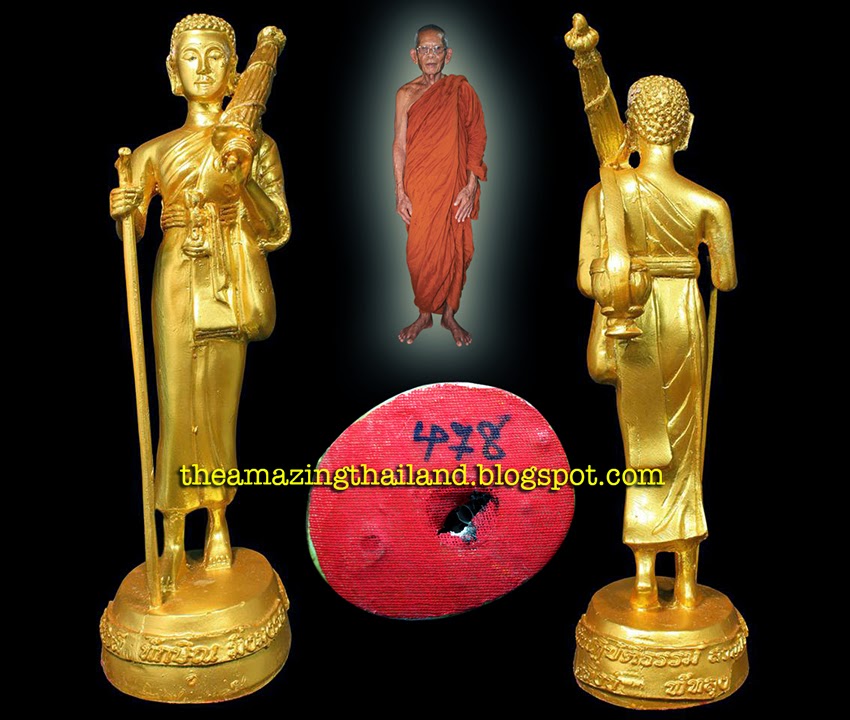
Phra Sivali buccha, Luang Pu Eaum, Sarmnak Song Taling Chan, Phattalung Province (B.E.2551)
![]() |
| 7cm x 8.5cm x 24cm (Length x Width x Height) |
Number : 478
Phra Sivali
In one of his past lives, Phra Sivali (Pāḷi: Sīvalī Thera) was blessed with the opportunity to see the Buddha Padumuttara (the 13th Buddha). At that time Buddha Padumuttara gave to a monk the honor of being foremost among his fellow monks obtaining the Four Requisites (1: food; 2: shelter; 3: robes; 4: medicine). Upon seeing the people offering an abundance of those Four Requisites to this particular monk, Sīvalī was deeply impressed and made a vow to attain a status in monkhood similar to that of the monk he had witnessed.
Buddha Padumuttara noticed Sīvalī’s earnest dedication and he told him that, in a future life time – at the time of Gotama Buddha – his strong determination to become foremost among the monks obtaining the Four Requisites would become reality.
Then, in the time of Gotama Buddha, Sīvalī was born as a prince. Legend has it that because of an unwholesome deed he had performed (as an unrighteous King creating a lot of suffering to his subjects) in one of his past lives, his mother had to carry Sīvalī in her womb for a period as long as seven years. When the seventh year had come his mother could not yet give birth for another six days. Then, on the seventh day she worried she might die soon, so she requested her husband – the King – to invite the Buddha and his disciples for a meal at the palace so that she could offer them food for their alms. The King conscented to her request, and took care of the preparation of the meal for the monks.
After the Buddha and his disciples had finished their meal they bestowed blessings upon the queen (Sīvalī’s mother), which caused her pains to cease. Then when the Buddha and his disciples had left the palace she give birth without any further problems. Thus a wealthy prince by the name of Sīvalī was born in this world. Remarkably, the pains and hardships of both royal family members and those of the people living in their Kingdom had ceased and made way for an abundance of food and wealth.
Later Sariputta would invite Sīvalī to join the monastic community to which the queen granted Sīvalī her permission to do so. Whilst his hair got shaven he contemplated on the 32 parts of the body and its impurities. Immediately after that Sīvalī attained liberation (Pāḷi: mokkha; Sanskrit: mokṣa - a synonym for nibbāna / nirvāṇa).
From that moment onwards, the monks started to notice that wherever Sīvalī went to travel, he and his fellow monks were never short of the Four Requisites. In fact, they were always given an abundance of offerings by the laity. The Buddha soon recognized that Sīvalī’s vow from the past had now come to fruition, thereby declaring him foremost among the monks obtaining the Four Requisites.
Apart from the fact that Sīvalī was an arahant disciple of the Buddha, and had played an essential role in taking care of the Four Requisites for the monks in the monastic community, Thai people worship Phra Sivali as an arahant with miraculous power to quickly attract an abundance of prosperity and wealth.
(The information about Phra Sivali is from others website. Just for reference.)
The below paragraph is Sivali mantra praying for good luck and fortune. Scale of success is based on your mind-power or will; the more concentrated, the more successful you are!!
"Sivali ja Mahathero Devatanarapuchito Soraho Pajjayatimhi Sivali ja Mahathero Yakkhadeva Puchito Soraho Pajjayatimhi Ahang Wanthami Tang Sathatassatherassa Aetang Khunang Sotthilabhang Bhavantumae."
***One of my friend who join us for the Kathin last weekend 12 October 2014 at Luang Pu Eaum's temple. Everyone received a Phra Sivali buccha direct from Luang Pu Eaum's hand. Then one of my friend get a very nice number 828. Everyone like that number. At that night, Damacai draw result 2nd prize 828. All of us so shock!***
Thanks for people who support us. This amulet has been rented.
Phra Sivali
In one of his past lives, Phra Sivali (Pāḷi: Sīvalī Thera) was blessed with the opportunity to see the Buddha Padumuttara (the 13th Buddha). At that time Buddha Padumuttara gave to a monk the honor of being foremost among his fellow monks obtaining the Four Requisites (1: food; 2: shelter; 3: robes; 4: medicine). Upon seeing the people offering an abundance of those Four Requisites to this particular monk, Sīvalī was deeply impressed and made a vow to attain a status in monkhood similar to that of the monk he had witnessed.
Buddha Padumuttara noticed Sīvalī’s earnest dedication and he told him that, in a future life time – at the time of Gotama Buddha – his strong determination to become foremost among the monks obtaining the Four Requisites would become reality.
Then, in the time of Gotama Buddha, Sīvalī was born as a prince. Legend has it that because of an unwholesome deed he had performed (as an unrighteous King creating a lot of suffering to his subjects) in one of his past lives, his mother had to carry Sīvalī in her womb for a period as long as seven years. When the seventh year had come his mother could not yet give birth for another six days. Then, on the seventh day she worried she might die soon, so she requested her husband – the King – to invite the Buddha and his disciples for a meal at the palace so that she could offer them food for their alms. The King conscented to her request, and took care of the preparation of the meal for the monks.
After the Buddha and his disciples had finished their meal they bestowed blessings upon the queen (Sīvalī’s mother), which caused her pains to cease. Then when the Buddha and his disciples had left the palace she give birth without any further problems. Thus a wealthy prince by the name of Sīvalī was born in this world. Remarkably, the pains and hardships of both royal family members and those of the people living in their Kingdom had ceased and made way for an abundance of food and wealth.
Later Sariputta would invite Sīvalī to join the monastic community to which the queen granted Sīvalī her permission to do so. Whilst his hair got shaven he contemplated on the 32 parts of the body and its impurities. Immediately after that Sīvalī attained liberation (Pāḷi: mokkha; Sanskrit: mokṣa - a synonym for nibbāna / nirvāṇa).
From that moment onwards, the monks started to notice that wherever Sīvalī went to travel, he and his fellow monks were never short of the Four Requisites. In fact, they were always given an abundance of offerings by the laity. The Buddha soon recognized that Sīvalī’s vow from the past had now come to fruition, thereby declaring him foremost among the monks obtaining the Four Requisites.
Apart from the fact that Sīvalī was an arahant disciple of the Buddha, and had played an essential role in taking care of the Four Requisites for the monks in the monastic community, Thai people worship Phra Sivali as an arahant with miraculous power to quickly attract an abundance of prosperity and wealth.
(The information about Phra Sivali is from others website. Just for reference.)
The below paragraph is Sivali mantra praying for good luck and fortune. Scale of success is based on your mind-power or will; the more concentrated, the more successful you are!!
"Sivali ja Mahathero Devatanarapuchito Soraho Pajjayatimhi Sivali ja Mahathero Yakkhadeva Puchito Soraho Pajjayatimhi Ahang Wanthami Tang Sathatassatherassa Aetang Khunang Sotthilabhang Bhavantumae."
***One of my friend who join us for the Kathin last weekend 12 October 2014 at Luang Pu Eaum's temple. Everyone received a Phra Sivali buccha direct from Luang Pu Eaum's hand. Then one of my friend get a very nice number 828. Everyone like that number. At that night, Damacai draw result 2nd prize 828. All of us so shock!***
![]() |
| Just a story for sharing. Not advice you for gambling! |
Tuesday, May 28, 2013
Buccha Phra Sivali, Luang Phor Maha Surasak, Wat Pradoo, Samut Songkhram Province (B.E.2555)
Made : 300 pieces.
Number : 237 (in Thai Numerals)
Phra Sivali
In one of his past lives, Phra Sivali (Pāḷi: Sīvalī Thera) was blessed with the opportunity to see the Buddha Padumuttara (the 13th Buddha). At that time Buddha Padumuttara gave to a monk the honor of being foremost among his fellow monks obtaining the Four Requisites (1: food; 2: shelter; 3: robes; 4: medicine). Upon seeing the people offering an abundance of those Four Requisites to this particular monk, Sīvalī was deeply impressed and made a vow to attain a status in monkhood similar to that of the monk he had witnessed.
Buddha Padumuttara noticed Sīvalī’s earnest dedication and he told him that, in a future life time – at the time of Gotama Buddha – his strong determination to become foremost among the monks obtaining the Four Requisites would become reality.
Then, in the time of Gotama Buddha, Sīvalī was born as a prince. Legend has it that because of an unwholesome deed he had performed (as an unrighteous King creating a lot of suffering to his subjects) in one of his past lives, his mother had to carry Sīvalī in her womb for a period as long as seven years. When the seventh year had come his mother could not yet give birth for another six days. Then, on the seventh day she worried she might die soon, so she requested her husband – the King – to invite the Buddha and his disciples for a meal at the palace so that she could offer them food for their alms. The King conscented to her request, and took care of the preparation of the meal for the monks.
After the Buddha and his disciples had finished their meal they bestowed blessings upon the queen (Sīvalī’s mother), which caused her pains to cease. Then when the Buddha and his disciples had left the palace she give birth without any further problems. Thus a wealthy prince by the name of Sīvalī was born in this world. Remarkably, the pains and hardships of both royal family members and those of the people living in their Kingdom had ceased and made way for an abundance of food and wealth.
Later Sariputta would invite Sīvalī to join the monastic community to which the queen granted Sīvalī her permission to do so. Whilst his hair got shaven he contemplated on the 32 parts of the body and its impurities. Immediately after that Sīvalī attained liberation (Pāḷi: mokkha; Sanskrit: mokṣa - a synonym for nibbāna / nirvāṇa).
From that moment onwards, the monks started to notice that wherever Sīvalī went to travel, he and his fellow monks were never short of the Four Requisites. In fact, they were always given an abundance of offerings by the laity. The Buddha soon recognized that Sīvalī’s vow from the past had now come to fruition, thereby declaring him foremost among the monks obtaining the Four Requisites.
Apart from the fact that Sīvalī was an arahant disciple of the Buddha, and had played an essential role in taking care of the Four Requisites for the monks in the monastic community, Thai people worship Phra Sivali as an arahant with miraculous power to quickly attract an abundance of prosperity and wealth.
(The information about Phra Sivali is from others website. Just for reference.)
Number : 237 (in Thai Numerals)
Phra Sivali
In one of his past lives, Phra Sivali (Pāḷi: Sīvalī Thera) was blessed with the opportunity to see the Buddha Padumuttara (the 13th Buddha). At that time Buddha Padumuttara gave to a monk the honor of being foremost among his fellow monks obtaining the Four Requisites (1: food; 2: shelter; 3: robes; 4: medicine). Upon seeing the people offering an abundance of those Four Requisites to this particular monk, Sīvalī was deeply impressed and made a vow to attain a status in monkhood similar to that of the monk he had witnessed.
Buddha Padumuttara noticed Sīvalī’s earnest dedication and he told him that, in a future life time – at the time of Gotama Buddha – his strong determination to become foremost among the monks obtaining the Four Requisites would become reality.
Then, in the time of Gotama Buddha, Sīvalī was born as a prince. Legend has it that because of an unwholesome deed he had performed (as an unrighteous King creating a lot of suffering to his subjects) in one of his past lives, his mother had to carry Sīvalī in her womb for a period as long as seven years. When the seventh year had come his mother could not yet give birth for another six days. Then, on the seventh day she worried she might die soon, so she requested her husband – the King – to invite the Buddha and his disciples for a meal at the palace so that she could offer them food for their alms. The King conscented to her request, and took care of the preparation of the meal for the monks.
After the Buddha and his disciples had finished their meal they bestowed blessings upon the queen (Sīvalī’s mother), which caused her pains to cease. Then when the Buddha and his disciples had left the palace she give birth without any further problems. Thus a wealthy prince by the name of Sīvalī was born in this world. Remarkably, the pains and hardships of both royal family members and those of the people living in their Kingdom had ceased and made way for an abundance of food and wealth.
Later Sariputta would invite Sīvalī to join the monastic community to which the queen granted Sīvalī her permission to do so. Whilst his hair got shaven he contemplated on the 32 parts of the body and its impurities. Immediately after that Sīvalī attained liberation (Pāḷi: mokkha; Sanskrit: mokṣa - a synonym for nibbāna / nirvāṇa).
From that moment onwards, the monks started to notice that wherever Sīvalī went to travel, he and his fellow monks were never short of the Four Requisites. In fact, they were always given an abundance of offerings by the laity. The Buddha soon recognized that Sīvalī’s vow from the past had now come to fruition, thereby declaring him foremost among the monks obtaining the Four Requisites.
Apart from the fact that Sīvalī was an arahant disciple of the Buddha, and had played an essential role in taking care of the Four Requisites for the monks in the monastic community, Thai people worship Phra Sivali as an arahant with miraculous power to quickly attract an abundance of prosperity and wealth.
(The information about Phra Sivali is from others website. Just for reference.)
The below paragraph is Sivali mantra praying for good luck and fortune. Scale of success is based on your mind-power or will; the more concentrated, the more successful you are!!
"Sivali ja Mahathero Devatanarapuchito Soraho Pajjayatimhi Sivali ja Mahathero Yakkhadeva Puchito Soraho Pajjayatimhi Ahang Wanthami Tang Sathatassatherassa Aetang Khunang Sotthilabhang Bhavantumae."
Subscribe to:
Posts (Atom)
%20copy.jpg)