Showing posts with label Mitmor. Show all posts

Thursday, June 4, 2026

[ Completed Collection ]

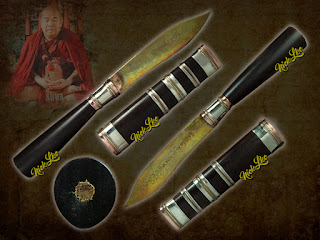
In mid-2019 (B.E.2562), Kruba Apiwat created four types of auspicious items by gathering various sacred materials to create these objects:
1. Teacher's wood stick (Mai Khru)
2. Ritual knife (Mitmor)
3. Cast statue (Roop Lor)
4. Locket with back plate

All these four items contain important sacred materials considered to be the best in the "Swe Yin Cho" lineage from Myanmar to Mae Hong Son. Kruba used more than 500 "Ang/Chama" plates from the lineage of the teacher, inscribed by his own benevolent teacher, and "Ayong To Sin" fire element beads from the lineage. These inscribed plates and sacred materials were used to create the statue, ritual knife, teacher's wood stick, and locket with back plate. They were then consecrated in various Buddhist, Deva, and Mangala ceremonies. These amulets were taken to various ceremonies as kindly provided by the hosts, and also received blessings and prayers from many virtuous and enlightened teachers (gaeji archans).

Friday, May 22, 2026

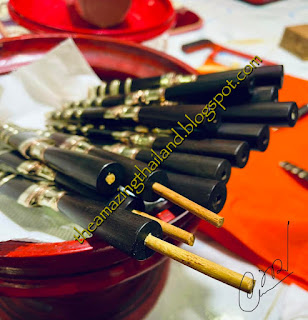
Mit Mor Akhom (magical knife) Phaya Maeng Phu Kham, 3rd batch, Kruba Phan Saen, Wat Pa Charoen Tham, Chiang Mai (B.E.2565).

Made : 108 pieces
No. : 2

A good item that consecrated inside the cave in B.E.2565. Size including sheath 9 inches.

(Made from the iron wheel of the cart, lacquared covered with real gold leafs and colour, embedded with 9 copper points)

This Mit Mor Akhom is composed of ten thousand Thai steel bars, making the blade look beautiful and strong. Not easy to made a piece of Mit Akhom. It is not in the eyes like a sacred object (Kreung Lang) that just showed beautiful, whereas it’s combines both science (magical) and art.

How to use it:

If you are cursed, shake it to various points on your body and keep chanting. If you want to use holy water to ward off evil spirits or make holy water to bathe and drink, shake the sharp side in the water and chant. If you want to make holy water to attract love and trade, use the bee's side to dip the water. If children or people in the house can't sleep and wake up in the middle of the night, remove the knife from the handle and put it under the pillow or on the head of the bed. Then pray.

Phaya Maeng Phu Kham (bumblebee), "The Recipe of 5 Pa", made of wood (old cart wheel hub) according to "The Recipe of 5 Pa", consecrated according to the Tai Yai sect. The virtues are loving-kindness, fortune, protection from danger, and the more you practice, the better. Phaya Malaeng Phu Kham is a Burmese science that uses materials related to the number 5 (Kruthat) or often called all 5 Pa, which are:

1. Patok = Rosewood
2. Patong = Cart wheel hub made from Rosewood
3. Patung = Bumblebee carved from the wood of the cart wheel hub
4. Pata = Mercury that is placed in the body of the bumblebee

5. Patang = Morning Glory flower (喇叭花 / 牽牛花) 

Made from patterned steel, 4-inch long blade, 9 copper points, 3.5-inch long handle made from rosewood, carved from wheel hub in the shape of a bumblebee (Phaya Maeng Phu Kham), filled with mercury and crazy eggplant wood, wrapped in copper, painted with black and red colour, then gilded with real gold leafs. Rosewood sheath carved with lotus lattice pattern, wrapped in copper, painted with black and red colour, gilded with real gold leafs.

Total length 9 inches, 108 pieces made. Income from worship is for building the royal hall of the teacher at Wat Pa Charoen Tham.

Friday, August 26, 2022

Mit Haek, made by Albino Buffalo Horn, Kruba Teelaphot, Wat Non Dtai (B.E.2563).

Size : 1 cm (Height) x 9 cm (Width) Lanna magic knife for healing. Lanna healer's knives called a "mithaek" or "mitmor" for healing a sick or spirit possessed person. Lanna Sastra Akhom Lanna sacred weapons are Sastra Akhom from part of the war history of various ethnic groups. Their role nowadays has changed from fighting to providing protection to the country to being ritual elements to remind the people of their value. Small knives or mitnoi or pra, according to the Tai Yong of Lamphun, like pradap (sword), prato (cleaver), prawaeng, pranoi and prapraisaeo (pointed knife) could be used as a weapon. Chiang Mai people have the word liam to mean pointed instead. There are also other types of knives such as mitnep (that can be tucked into the waistband of trousers), mitnum and mitsui. Mitnoi or Pranoi Mitnoi or pranoi refers simply to small knives of about six inches in length and mostly with a pointed tip to be carried by tucking them at the belly or waistband. The longer one, mitsok, is about the length from the elbow to the fingertips; it can be used for kitchen work or carried in a shoulder bag or tucked in the back suspended by a string when riding on an elephant or a buffalo or when climbing a tree. Its sheath and handle can be decorated more elaborately than kitchen knife. A knife whose handle is made of ivory and kept in a silver sheath is kept as a collector's item and is hardly used in daily activities. It is polished and coated with oil so that it will survive better. This type of knife came from Shan State; so it is an imported item or one made by a foreigner not the local Tai Yuan people. Antique traders around the border confirmed that these knives were brought by the Tai Yai from Myanmar long ago. The knives with ivory handles and silver sheaths from Shan State belonged to the well-to-do people. Only a few commoners could afford to have them specially from carved ivory or animal teeth. Besides being useful as decorative items, they were also used by medicine men/ shamans for healing certain diseases and for ritual performances. The ivory handle and the silver sheaths are hard to repair so it is difficult to find one in perfect condition. The iron or ore used to make the knives was of a high quality found in Mueang Nong and Mueang Ton in Shan State. Cattle traders brought them along to sell. During the period when antiques became popular and in high demand, the Tai Yai antique agents would go around every village and bring out swords, knives, tube skirts, baskets, etc., so all kinds of antiques were left in stacks around Chiang Mai, Mai Sai and Mae Sot, and some found their way to Chatuchak Market in Bangkok 4-5 years ago. A nice looking knife could earn over a thousand Thai Baht and now it can fetch as much as ten thousand Baht. *Mit Haek Mit Haek is a small knife. The word haek in Lanna culture means to scrape or rub. Mit Haek is inscribed with incantations to heal diseases or ward off evil spirits, like mitmor. Several Lanna scholars and experts have stated that they were made from a special quality metal. The blade is not sharp and the tip is not pointed. They could also be made of the tooth of a tiger or a boar as well as ivory, albino buffalo horns, gaur horns, shells or even wood shaped like a knife or just a plain tooth or ivory itself.

Saturday, February 19, 2022

Mitmor / 灭魔刀 Narai Trung Tripop 1, Kruba Apiwat, Wat Thung Pong (B.E.2565).

Size : 19 cm (Long) x 1.9 cm (Width)
Blade : 9.6 cm (Long)
With sheath : 20 cm

Made: 108 pieces
(Released to Public : 93 pcs)

Mitmor (Magical Knife) is a type of Kreung Lang that has been in the beliefs of Thai people for a long time. But with many widely known people is inevitable. A Mitmor that resembles a deity with the power of your grace. Phra Khru Niwat Thammakhan (Luang Phor Derm Buddhasaro) is the god of the four Kwai cities. As well as to the disciples of the Lord who had studied all the sciences of that magic which is famous as a seeker of popular talismans.

There are many schools of Mitmor built in the North, Central, South, and Northeastern regions. There are many textbooks passed down from old teachers. Both monks and lay teachers (Ajarn / Archan / Ajahn / Kerawat /Bomoh) have taught students from that school. If created for distribution only to a group of people who study polytechnics in that school, it is often referred to as "Kru's knife", which is a magical knife that the teacher gives to different students. In order to protect himself from the dark magic or dangers that swarmed in.

As for the Mitmor (in my view) should be divided into two words, knives + healers. “Mit / Knife” is an object made of mostly steel. Or made of other metals such as brass, copper, bronze, flat and sharp on one side. Or those with physical and mental disorders If it's a superstitious treatment, it's popular to call a shaman, a kerawat, a bomoh, a healer, a archan, etc. If it's a scientific treatment, it's popular to call a doctor, a female doctor, who classifies the treatment according to the symptoms of that disease. For example, psychiatrists treat mental disabilities, madness, psychosis, dentist treats teeth, veterinarians treat sick animals, etc.

Knife+Doctor (Mitmor) when these two words are combined. It probably means It is a weapon or tool used to save lives. Cure physical and mental disorders caused by demonic invasions. Or various superstitious methods, such as Khun Sai, charming charms, embedding images according to those ancient beliefs. Or it is a weapon used to save one's life from the dark magic and various perils to survive, so it's called a “Mitmor” (this is my own attitude).

Often it is a knife made from various mystical metals, such as the top of the castle, the top of the chedi, the top of the pagoda, the steel of the monks. Steel gallows to burn ghosts, steel pierced corpses, steel fistulas polished doors. Various mystical iron according to the textbook. These were then mixed together and created (I don't know how you melted this one), as in the story of Khun Chang Khun Phaen mentioned when Khun Phaen revived the sword of the sky.

"Will arrange to strike the sword to defeat the battle
contemplating heavy iron
Has completed the mood according to the textbook
He placed it in the Mahasarakom
Take the iron at the top of Phra Chedi Mahathat
The top of Dwaramaprasat Castle
Iron Khan ghost ghosts die all round.
Steel rivet coffin, wind engraved diamond sculpture.
Bronze spear, broken copper dagger
Iron skewers engraved on the door with mushroom nails.
with mixed steel
Iron house ready to complete everything.
Cast iron in the Phra Saeng pond.
Nam Phi Iron Wall and Iron Ore
bronze
real silver, iron, copper, dong
take control into a bar
Burned to red, unfolded, soaked in powdered medicine.
for three days the iron smashed into smaller pieces.
Still, but as beautiful as the textbook
Finished slashing the iron seven times.
until the auspicious day of Saturday fifteen
then cut down trees and planted a shrine
and supply all kinds of card machines"

It is believed that these iron mystics can suppress many very bad things. If cut the hand and cut the meat believed to be incurable too, must be cursed by iron and magic. Or will it be because of a giant fight, it's unpredictable. If people do not have faith, they will be ignorant.

Let me tell you this today. Let's read and have fun in the covid era. That's enough. Please use your discretion too...
(Photo Credit To The Owner)
Contains a powder that deals with solving various mysteries. Contains all five weapon takruts. And hammered the wedge with lightning jackfruit wood (the color may not match the color of the handle)☺️

...that is where lightning strikes, even the hardened steel melts. The stone that is hard is still cracked. It is believed that the best weapon of Indra and the beast. Often appears in the form of a lightning bolt. Fell from the sky onto the ground… 

Friday, December 17, 2021

Mit Mor / Mit Haek with special Silver Ring (Lanna magic knife for healing), Nur Maha Chanuan with Pradu/ Rosewood handle (紫檀木手柄), Phra Ajahn Teelaphot, Wat Non Dtai (B.E.2564).

Lanna magic knife for healing. Lanna healer's knives called a "mithaek" or "mitmor" for healing a sick or spirit possessed person. 

Lanna Sastra Akhom

Lanna sacred weapons are Sastra Akhom from part of the war history of various ethnic groups. Their role nowadays has changed from fighting to providing protection to the country to being ritual elements to remind the people of their value. Small knives or mitnoi or pra, according to the Tai Yong of Lamphun, like pradap (sword), prato (cleaver), prawaeng, pranoi and prapraisaeo (pointed knife) could be used as a weapon. Chiang Mai people have the word liam to mean pointed instead. There are also other types of knives such as mitnep (that can be tucked into the waistband of trousers), mitnum and mitsui.

Mitnoi or Pranoi

Mitnoi or pranoi refers simply to small knives of about six inches in length and mostly with a pointed tip to be carried by tucking them at the belly or waistband. The longer one, mitsok, is about the length from the elbow to the fingertips; it can be used for kitchen work or carried in a shoulder bag or tucked in the back suspended by a string when riding on an elephant or a buffalo or when climbing a tree. Its sheath and handle can be decorated more elaborately than kitchen knife. 

A knife whose handle is made of ivory and kept in a silver sheath is kept as a collector's item and is hardly used in daily activities. It is polished and coated with oil so that it will survive better. This type of knife came from Shan State; so it is an imported item or one made by a foreigner not the local Tai Yuan people. Antique traders around the border confirmed that these knives were brought by the Tai Yai from Myanmar long ago. The knives with ivory handles and silver sheaths from Shan State belonged to the well-to-do people. Only a few commoners could afford to have them specially from carved ivory or animal teeth. Besides being useful as decorative items, they were also used by medicine men/ shamans for healing certain diseases and for ritual performances. The ivory handle and the silver sheaths are hard to repair so it is difficult to find one in perfect condition. The iron or ore used to make the knives was of a high quality found in Mueang Nong and Mueang Ton in Shan State. Cattle traders brought them along to sell. During the period when antiques became popular and in high demand, the Tai Yai antique agents would go around every village and bring out swords, knives, tube skirts, baskets, etc., so all kinds of antiques were left in stacks around Chiang Mai, Mai Sai and Mae Sot, and some found their way to Chatuchak Market in Bangkok 4-5 years ago. A nice looking knife could earn over a thousand Thai Baht and now it can fetch as much as ten thousand Baht.
Mit Haek Mit Haek is a small knife. The word haek in Lanna culture means to scrape or rub. Mit Haek is inscribed with incantations to heal diseases or ward off evil spirits, like mitmor. Several Lanna scholars and experts have stated that they were made from a special quality metal. The blade is not sharp and the tip is not pointed. They could also be made of the tooth of a tiger or a boar as well as ivory, albino buffalo horns, gaur horns, shells or even wood shaped like a knife or just a plain tooth or ivory itself.
Chanuan (slate) created The Ektipphamon Luang knife is as follows:
1. Golden Phra That Cho Hae, Phrae Province. 
2. Thong Phra That Doi Suthep, Chiang Mai Province. 
3. Thong Changko Phra That, Wat Akko Chai Khiri, Lampang Province.
4. Thong Changko Phra That Don Tao Suchadaram, Lampang Province.
5. Thong Changko, Wat Phra That Sadet Lampang Province. 
6. Thong Changko, Wat Phra That Nong Chan, Phrae Province. 
7. Thong Changko, Wat Phra That Sri Don Kham, Huai Or, Phrae Province.
8. Old tiered chedi in the Chiang Saen period. 
9. Top tiered chedi of Wat Nun Tai, Phrae Province. 
10. The sangkhawanon nail (temple nail) nailing the relics of Wat Suan Dok, Chiang Mai Province.
11. The nails of the monks in the reign of King Rama V, stamping the seal of the Por Po Ror (The King's Logo). 
12. Chuan Yod Naphasoon Ajarn Tee's Office Knitting rope.
13. Viharn bell, Wat Bo Haeo, Lampang Province.
14. The Viharn bell of Wat Long Lue Boon, Phrae Province.
15. Old bronze bell, chanuan (slate) casting Phra Chai Khu Khai.
16. Phra Lek Lai Yod Phra That Phanom.
17. Phra Phayakkhaphum Hall Maha Sarakham Province.
18. The casting slate of Luang Phor Sompratana, Wat Rong Khem, Phrae Province.
19. Slate of Phra Chao Kao Tue, 500 years of Wat Suan Dok, Chiang Mai Province.
20. A slate casting a statue like Chao Khun Phra Mongkhon Suthi (Luang Pu Khaek Paphaso), Wat Sunthon Pradit, Bang Rakam District, Phitsanulok Province.
21. Hom Maha Mongkhon Chai Office, Chiang Mai Province.
22. Slate from Wat Saphan Sung lineage.
23. Slate from Archan Prakhong, Roon Charoen-porn.
24. Slate from Narai Sanghan Yant, Promprasit House.
25. Slate of Phra Khong.
26. Phaya Hor Mara Slate, Lanna Slate, Chiang Saen bronze Buddha image.
27. Phra Chai Ayutthaya fragments.
28. Old bronze Buddha images.
29. Old Lightning Rod at Long Lue Boon Temple Phrae.
30. Tok Nan money.
31. Tok Chiang Mai money.
32. Phaen Pump Phra Phuttha Chinnarat 1929 (B.E.2472).
33. Old Lanna ancient Takrud.
34. 7 bronze lightning axes.
35. Bronze arrowheads.
36. 25 pieces copper plates of the Kanchai Saree Sword Yantra, 1.10 meters long.
37. Over 20 kilograms of old bronze.
Various famous medicine powders.
The medicine powders has been mixed together.
Fill until it comes down in the closing end.  
Filled during Buddhist Day.
Paint with lacquered.
With silver ring.
It's done.